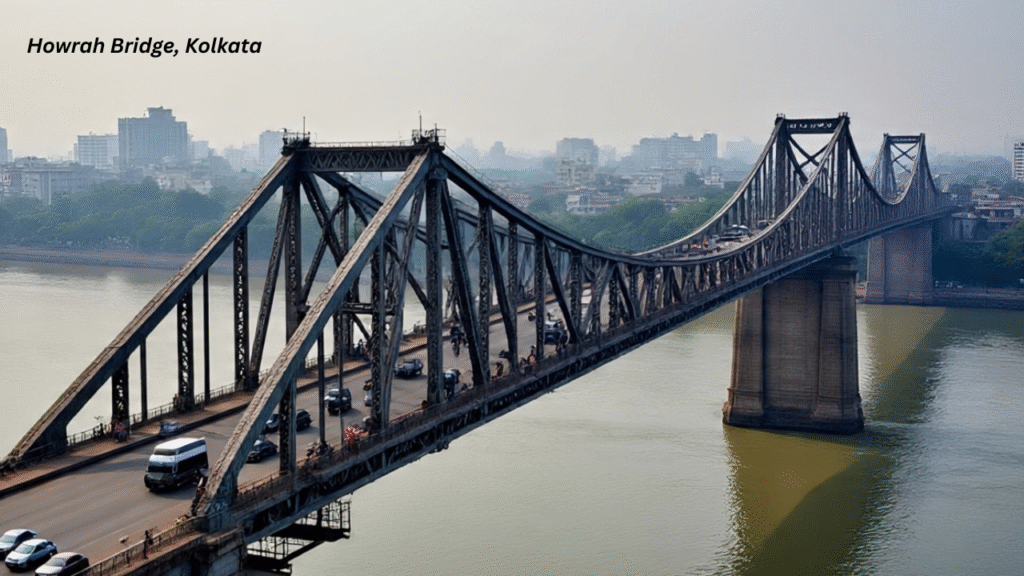
The Howrah Bridge opened in 1943 is one of Kolkata’s most famous places and a landmark that makes India proud . The bridge connects Howrah city with Kolkata across the Hooghly River to link between these two major areas . This bridge surely ranks among the world’s busiest transportation routes. Moreover, it has maintained its significance as a major crossing point for decades. This bridge is actually special because engineers built it without any nuts and bolts. The structure definitely stays strong only through rivets that hold all parts together. The bridge is 705 meters long and handles thousands of cars and people walking across it every day. Most people are calling it Howrah Bridge but in fact this bridge name changed to Rabindra Setu to honor the great poet Rabindranath Tagore after independence of India.

1. No Nuts, No Bolts : The Howrah Bridge was built without using a single nut or bolt unlike other bridges. It was completely built together by 26,500 tons of steel rivets.
2. A Floating Bridge: The bridge constructed without having a single pillar in the water. This bridge floats over the Hooghly River and it allows the ships and boats to pass freely underneath.
3. Steels imported from England : The special high-tensile steel used to build the bridge was imported from England. However, Tata Steel in India also contributed for marking a proud moment for the Indian industry in the 1940s.
4. Renamed After Independence: Originally it’s called as New Howrah Bridge, but after independence it was renamed as Rabindra Setu in 1965 in honor of the great poet Rabindranath Tagore.
5. Busiest Bridge in the World : More than 100,000 vehicles and over 150,000 pedestrians crosses the bridge in every single day.
6. Survived World War II Bombings : During World War II the Japanese bombers tried to attack the bridge but nothing damaged.
7. Changing Colors With Time : The bridge was painted silver at the beginning. Later, due to the high cost of maintenance, it was repainted in grey color.
8. A Record-Breaker in Its Time : The bridge was completed in 1943 and it was the third-longest and most iconic cantilever bridges in the world.
9. Restriction on Fishing : Due to busy traffic across the Hooghly River, fishing from the bridge is strictly banned .
10. The Bridge That Breathes : The bridge expands and contracts almost a meter every day due to temperature changes.
11. Destination for Filmmakers: Howrah Bridge has been one of the destinations for filmmakers for its iconic value. The classic Hindi movie Howrah Bridge (1958) to modern hits.