
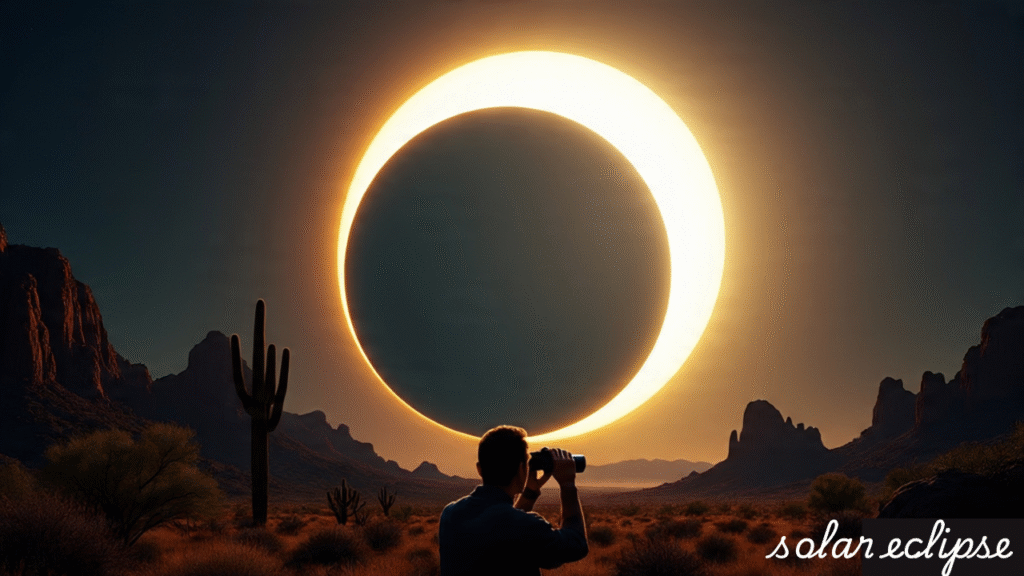
A solar eclipse happens when the Moon moves between the Sun and the Earth. This blocks the sunlight from reaching the Earth for a short time. There are three types of solar eclipses – total, partial, and annular. During a total eclipse, the Moon covers the Sun completely and it becomes dark for a few minutes. In a partial eclipse, only a part of the Sun is covered. An annular eclipse happens when the Moon is far from the Earth and looks smaller, so the Sun looks like a bright ring around it. Solar eclipses do not happen very often in the same place. People wear special glasses to safely watch this amazing event without hurting their eyes.

Here are 11 facts about solar eclipse
1.A solar eclipse happens when the moon moves between Earth and sun. The moon blocks sunlight and creates shadow on Earth itself.
2. We are seeing three types of solar eclipses only like, total, partial, and annular. It is based on how much the Moon covers the Sun. A total solar eclipses happen once in every 18 months somewhere on Earth.
3. During a total solar eclipse, the sky becomes dark the same as nighttime, and you can see stars and planets for a few minutes.
5. Some animals mistake the eclipse for nightfall and act like it’s evening, because the sky gets dark and the temperature drops during the total eclipse.
6. As per safety guidelines, looking directly at the Sun during eclipse without proper protection can damage your eyes. Regarding eye safety, this can even cause permanent blindness.
7. Basically, ancient people thought solar eclipses were the same as messages from gods or dangerous signs, so they did many rituals.
8. We are seeing that total solar eclipses can last for about 7 minutes only at the longest, but most eclipses are lasting for only a few seconds to some minutes.
9. Scientists surely use solar eclipses to study the Sun’s outer layer, called the corona, which is normally hidden by the Sun’s bright light. Moreover, this special time allows researchers to see and examine the corona clearly without any interference.
10. Solar eclipses happen 2 to 5 times every year on Earth, but getting a total eclipse at the same location is much more rare. Partial solar eclipses can be seen from places up to 3,000 miles away from the path where the total eclipse is visible.
11. You need special eclipse glasses to watch a solar eclipse safely because normal sunglasses are not the same level of protection for your eyes.