
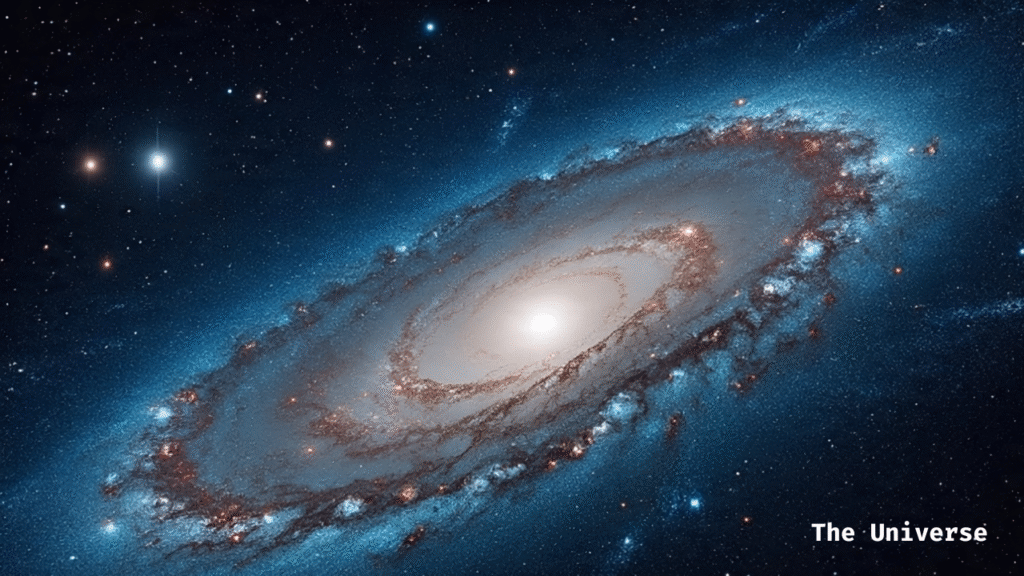
The universe is everything which exists all the stars, planets, galaxies and space. It started about 13.8 billion years ago with a huge explosion called the Big Bang. Since then, it has been growing bigger and bigger. There are billions of galaxies are exists in the universe and each galaxy has millions or even billions of stars. Our planet Earth is a small part of the Milky Way galaxy. Scientists are still searching and learning about how the universe works and more about universe. The universe is full of mysteries and every day the scientists discovers something new and interesting facts. It is so vast that we cannot easily imagine its size or age. Even though it looks very far, everything in its affects us and makes our earth unique.
Here are 111 Interesting Facts About the Universe !
- The universe is about 13.8 billion years old. It began with the Big Bang.
- The universe is constantly expanding as Galaxies are moving away from each other over time.
- There are more stars in the universe than grains of sand on all Earth’s beaches.
- Our galaxy i.e. the Milky Way has exist about 100 to 400 billion stars.
- The universe contains over 2 trillion galaxies which beyond our imagination!
The Light from distant stars can take millions or billions of years to reach us. - Black holes are regions where gravity is so strong that even light cannot escape.
- The largest known star is UY Scuti which is about 1,700 times wider than our Sun.
- The universe is mostly made of dark matter and dark energy.
- Dark energy causes the universe to expand faster and faster.
- The Sun is a star and it is just much closer to Earth than others.
- Neutron stars are so dense that a sugar-cube-sized piece would weigh a billion tons.
- Our Solar System is about 4.6 billion years old.
- There might be life on other planets. Scientists are still searching on it.
- The Moon is moving away from Earth by about 3.8 centimeters each year.
- Jupiter is the fifth planet from the Sun and the largest in the solar system
- Saturn’s rings are made mostly of ice and dust.
- A day on Venus is longer than a year on Venus.
- Mars has the tallest volcano in the Solar System, Olympus Mons.
- The universe might be infinite. Scientist are even not sure !
- There is a giant cloud of alcohol in space. Which is enough to make 400 trillion pints of beer!
- A spoonful of a neutron star would weigh as much as all humans on Earth.
- The cosmic microwave background is leftover heat from the Big Bang.
- The Milky Way and Andromeda galaxies will collide in about 4 billion years.
Space is completely silent. As there is no air to carry sound waves. - The footprints left on the Moon will stay for millions of years.
- The largest structures of the universe are called galaxy superclusters.
- The Andromeda Galaxy (M31) is the closest spiral galaxy to us.
- The fastest spacecraft ever built i.e. Parker Solar Probe which can travel at over 700,000 km/h.
- There are rogue planets that drift through space without a star.
- Some black holes spin near the speed of light.
- The universe began from a singularity, which is a point smaller than an atom.
- A light-year is the distance light travels in one year.
- The universe is 10 million billion or more kilometers across!
- The tiny particles of Neutrionos pass through almost everything unnoticed.
- Our galaxy is shaped like a spiral with swirling arms.
- The Sun makes up 99.8% of the mass in our Solar System.
- The largest galaxy, IC 1101, is over 6 million light-years wide.
- Space telescopes, like Hubble are helping us see faraway galaxies.
- The universe is mostly empty space between stars and galaxies.
- Some stars are so massive that, they explode in supernovae.
- Gamma-ray bursts are the most energetic explosions in space.
- The universe’s temperature is about 2.7 Kelvin, almost absolute zero.
- The Milky Way’s center holds a supermassive black hole called Sagittarius A.
- Some planets are made of diamond!
- The nearest star i.e. Proxima Centauri is about 4.24 light-years away.
- The stars of our galaxy orbit around its center once every 225–250 million years.
- There is a theory of multiverse i.e. many universes beyond ours.
- The universe is oldest known galaxy, which is over 13 billion years old.
- The largest known structure i.e Hercules-Corona Borealis Great Wall, stretches 10 billion light-years!
- Comets are made of ice, dust, and rocks.
- The asteroid belt is between Mars and Jupiter.
- The expansion of the universe is measured using redshift.
- The gravity of Sun keeps the planets in orbit.
- Some stars are more hot as compare to Sun.
- There are clouds of gas that create new stars called nebulae.
- Some galaxies are shaped like ellipses instead of spirals.
- Scientists believe that the first stars formed about 200 million years after the Big Bang.
- Most of the stars are born from the spiral arms our galaxy.
- Scientists use radio telescopes to detect the distant cosmic signals.
- Planets far from their stars can still have atmospheres.
- Quasars are extremely bright centers of galaxies powered by black holes.
- The oldest light of the universe was emitted about 380,000 years after the Big Bang.
- Some moons, like Europa may have oceans beneath their surfaces.
- Space travel requires huge amounts of energy to escape gravity.
- The universe has no edge that we can find.
- The coldest place in space is the Boomerang Nebula.
- Space debris is a growing problem for the satellites.
- Some planets have rings like Saturn, but they are smaller.
- The largest known star clusters have millions of stars.
- Pulsars are rapidly spinning neutron stars emitting beams of energy.
- The universe might eventually collapse back into itself, or expand forever.
- The dust in Space can create beautiful colors in nebulae.
- Some planets orbit two stars instead of one.
- There are cosmic rays that travel near the speed of light.
- The Hubble Space Telescope has discovered thousands of new galaxies.
- Space is vast and mostly unexplored.
- Our Solar System is located in one of the galaxy’s outer arms.
- The powerful gravitational waves are created due to merge of some black holes.
- The Big Bang wasn’t an explosion in space, but space itself expanding.
- There are stars that pulse and change brightness regularly.
- Some galaxies are colliding right now.
- The Sun will one day turn into a white dwarf.
- Space has regions where no stars or matter exist.
- The expansion of the universe is faster than light at the edges.
- Exoplanets are planets , which are exists beyond our Solar System.
- Some planets are made mostly of gas with no solid surface.
- The universe may have more dimensions than the three we see.
- Black holes can warp space and time.
- The nearest galaxy cluster to us is the Virgo Cluster.
- Cosmic inflation made the universe expand quickly in its early moments.
- Some stars live billions of years, while others die quickly.
- The universe is mostly invisible because dark matter and dark energy can’t be seen.
- Scientists study space to learn more about the origins of our earth.
- There are billions of potentially habitable planets.
- Some stars form in pairs or groups.
- Space has a very low density, which means it’s almost empty.
- A black hole’s gravity can bend light around it.
- Neutron stars can spin hundreds of times per second.
- Space missions have traveled as far as the edge of our Solar System.
- The universe’s background radiation is like a faint glow everywhere.
- Some planets have retrograde rotation, spinning in the opposite direction.
- Scientists think a particle called the Higgs boson gives mass to matter.
- Gravitational lensing helps us to see the distant of galaxies by bending light.
- Space is so cold that atoms move very slowly.
- There are regions where stars are born from clouds of dust and gas.
- https://science.nasa.gov/universe/black-holes/types/.
- The mysteries of the universe keep the scientists searching for new discoveries.
- Space can stretch and ripple due to gravitational waves.
- Scientists use supercomputers to simulate the formation of the universe.
- The universe is full of wonders we are only beginning to understand.
- Some planets go around their stars very closely, making their surfaces so hot that metal could melt.
- Some galaxies spin so fast that the stars at the edges are almost flying away into space.